
Introducing the Quanxira Digital PCR Platform — a fully integrated, chip-based digital PCR system designed to deliver absolute quantification, ultra-high sensitivity, and scalable multiplexing for advanced research and clinical applications.
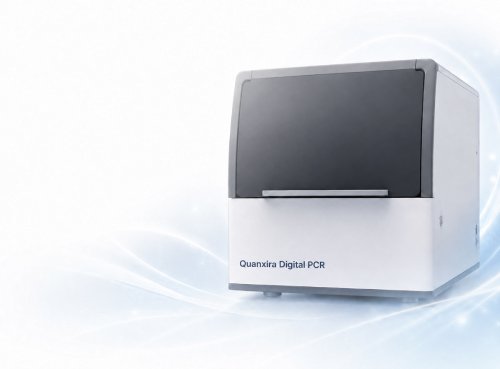
All-in-One Digital PCR — From Sample to Answer
Unlike conventional workflows, the system integrates:
Sample loading
Droplet generation in Chips
PCR amplification
Signal detection & analysis
into a single fully automated platform
✔ Minimal hands-on time (~1 minute preparation)
✔ Fully closed system — no manual transfer steps
✔ Reduced variability and improved reproducibility
Key Advantages
1. Absolute Quantification with Superior Sensitivity
Absolute quantification without standard curves
Detection of rare mutations
No interference from wild-type background
2. Ultra-Multiplex Capability
Powered by Exponential Ultra-Multiplex Technology:
Up to 63-plex detection in a single run
Not limited by fluorescence channel count
Enables high-density biomarker panels
3. AI-Driven Data Analysis
Automated droplet classification
Intelligent noise reduction
High-confidence positive/negative calling
4. High-Stability Microfluidic Chip Technology
Our proprietary SS chip-based system features:
20,000 partitions per chip
95% effective droplet yield
99% droplet uniformity
Advantages:
Superior stability vs droplet systems
Minimal droplet fusion or loss
Higher signal-to-noise ratio
5. Fully Automated Workflow
Hands-on time: ~1 minute
Total runtime: ~3–4 hours
Three simple steps:
Load sample
Start run
Analyze results
System Performance
Sensitivity: 0.01% detection level
Dynamic range: 5 logs
Precision: ±10%
Throughput: 24 samples per run
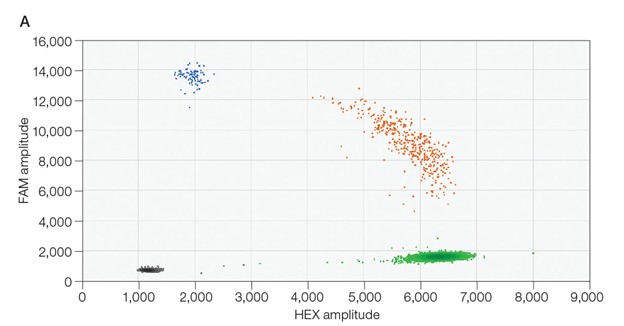
Fluorescence channels: up to 6+1 channels
Flexible Chemistry & Open System Compatibility
Compatible with multiple PCR mixes
Supports probe-based and dye-based assays
Enables rapid assay development
Applications
1. Oncology & Precision Medicine
Rare mutation detection
MRD monitoring
Tumor methylation analysis
2. Infectious Disease
Respiratory pathogen panels
Viral load quantification
Multiplex pathogen detection
3. Biopharma & Cell/Gene Therapy
Vector copy number
Residual DNA detection
QC for biologics
4. Neurology & Biomarkers
5. Environmental & Food Safety
Technology Comparison
Feature | Quanxira dPCR | Bio-Rad QX | Stilla |
Partitioning Method | Microfluidic Chip | Droplet | Microfluidic droplet array |
Partitions | >20,000 | ~20,000 | ~30,000 |
Multiplexing | Up to 63-plex | 2–4 plex | 3–6 plex |
Workflow | Fully Automated | Semi-manual | Semi-automated |
Hands-on Time | ~1 min | 15–30 min | 10–20 min |
Droplet Stability | High (chip-based) | Medium | Medium |
Cross-contamination Risk | Low (closed system) | Medium | Medium |
AI Data Analysis | Integrated | Limited | Limited |
Multi-Omics Capability | Yes (DNA + Protein) | DNA only | DNA only |
Applications of Quanxira Digital PCR Platform
Proprietary SS Chip Technology
Engineered for Precision. Built for Performance.
At the core of the Quanxira™ digital PCR platform is a proprietary glass-based microfluidic chip architecture, designed to deliver superior thermal control, optical clarity, and partition consistency—enabling highly reliable digital quantification across a wide range of applications.
Advanced Sandwich-Structured(SS) Chip Design
Our chip features a patented glass-based sandwich structure, integrating microfluidic partitioning with optimized thermal and optical properties in a single platform.
Key capabilities include:
>20,000 high-uniformity microwells per chip
Enhanced thermal conductivity for improved reaction uniformity
High optical transparency for superior signal detection
Low background noise enabling higher signal-to-noise ratios
This architecture ensures consistent amplification conditions across all partitions, improving both quantification accuracy and reproducibility.
Superior Partition Integrity and Stability
Unlike traditional droplet-based systems, the SS Chip is engineered to support highly stable partitioning environments, minimizing variability introduced by droplet fusion or loss.
≥95% effective partition utilization
≥99% partition uniformity
Reduced variability across runs and operators
This results in more statistically robust data and improved confidence in low-abundance target detection.
Designed for Multi-Modal Compatibility
The chip is built to support a broad range of assay chemistries, enabling seamless integration across different molecular workflows:
Digital PCR (dPCR)
Isothermal amplification
Digital immuno-PCR and protein detection
This flexibility allows laboratories to expand beyond nucleic acid testing and adopt future-ready digital biology applications on a single platform.
Features comparison among ddPCR technologies:
Feature | Semiconductor Chip Systems | Droplet-Based Systems | SSC Microfluidic Chip |
Partition Stability | Limited stability due to manual partitioning | Prone to droplet fusion | Ultra-high partition stability |
Effective Partition Utilization | Lower effective partitions | Higher droplet loss | High effective partition ratio (≥95%) |
System Design | Open system | Manual, open system | Fully automated, closed system |
Workflow Efficiency | Moderate | Longer workflow | Shorter detection time |
Device Cost | Lower upfront cost | Higher device cost | Cost-efficient system design |
Consumable Cost | Higher consumable costs | Higher consumable costs | Low consumable cost |
Reproducibility | Moderate (operator-dependent) | Variable (droplet variability) | High reproducibility across runs |
Scalability & Automation | Limited automation | Limited automation | Fully integrated automation-ready platform |
Thermal uniformity | Variable | Variable | Highly uniform |
Optical performance | Limited by material | Limited by material | High transparency glass |
System design | Open or semi-open | Open or semi-open | Fully integrated, closed-compatible |
Performance and System Specifications
Category | Parameter | Specification | Customer Value |
Sensitivity | Analytical Sensitivity | 0.01% VAF | Enables detection of rare mutations and low-abundance targets |
Dynamic Range | Quantification Range | 5 orders of magnitude | Accurate quantification across a wide concentration range |
Partition Quality | Usable Partition Rate | ≥95% | Maximizes effective data points for statistical confidence |
Partition Uniformity | ≥99% | Ensures consistent partition volume and improves reproducibility | |
Precision | Quantification Precision | CV ≤7% | Reliable absolute quantification across runs |
Throughput | Samples per Run | Up to 24 samples | Supports medium-throughput workflows |
Sample Input | Input Volume | 25–30 μL | Compatible with standard workflows |
Partitioning | Partitions per Chip | >20,000 | High-resolution digital quantification |
Detection | Optical System | CMOS imaging | High sensitivity and signal accuracy |
Excitation Source | LED | Stable, low-maintenance illumination | |
Multiplexing | Fluorescence Channels | Atto425, FAM, HEX, ROX, Cy5, Q705 (+ expandable) | Flexible multiplex assay design |
Speed | Read Time | <0.5 min/sample/channel | Rapid data acquisition |
Instrument | Dimensions | 440 × 628 × 497 mm | Compact benchtop footprint |
Interface | Software UI | English | User-friendly global deployment |
Ordering Info:
Cat. No. | Description | Size |
70001 | Digital PCR System | Unit |