
A Next-Generation Engine for Methylation Marker Discovery
Guide Positioning Sequencing (GPS) is a proprietary whole-genome DNA methylation discovery technology, developed to overcome the core limitations of conventional bisulfite-based methylome methods. GPS enables high-resolution, genome-wide methylation profiling with cytosine coverage as high as 96%, while maintaining strong performance in GC-rich regions, CpG islands, and repetitive elements—areas where traditional approaches often underperform.
Unlike standard whole-genome bisulfite sequencing (WGBS), GPS was designed not only to improve methylation detection accuracy, but also to expand the practical utility of methylome data for biomarker discovery, tumor biology research, and clinical translation.
Li J, et al. Guide Positioning Sequencing identifies aberrant DNA methylation patterns that alter cell identity and tumor-immune surveillance networks. Genome Res. 2019 Feb;29(2):270-280.
Why GPS Matters
DNA methylation is one of the earliest and most informative molecular signals in cancer development. But the value of methylation-based diagnostics depends on how accurately and comprehensively methylation can be measured across the genome.
Conventional WGBS remains a widely used research method, yet it has inherent limitations in mapping efficiency, sequence complexity, and coverage bias after bisulfite conversion. In the original Genome Research publication, GPS was introduced specifically to address these issues and provide a more accurate framework for global methylation analysis.
GPS, therefore, serves as the discovery backbone behind our methylation marker platform, enabling the identification of robust cancer-associated epigenetic signatures with broad translational potential.
How GPS Works
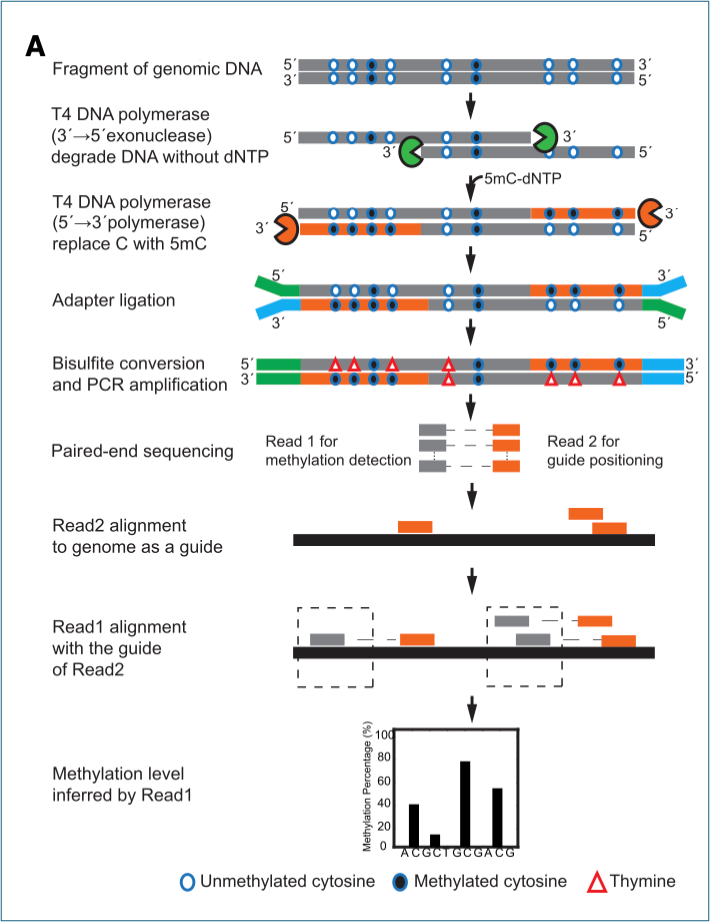
GPS uses a paired-end sequencing strategy in which one read preserves genome-positioning information and the other supports methylation-state inference. This “guide-positioning” concept improves alignment performance and reduces the information loss commonly associated with bisulfite-only workflows. The workflow diagram in the Genome Research paper shows how genomic fragments are processed so that one read anchors accurately to the reference genome and guides methylation calling from the paired read.
This design allows GPS to:
improve read alignment accuracy
preserve higher effective sequence complexity
expand methylation coverage across difficult genomic regions
generate both epigenetic and genetic information in a single experiment
Key Technical Advantages
1. Exceptional genome-wide coverage
GPS achieved 96% cytosine coverage and detected 97% of CpG sites in human liver samples in the published study, supporting truly broad methylome interrogation at a whole-genome scale.
2. Better performance than WGBS in difficult regions
Compared side-by-side with WGBS, GPS showed stronger coverage in:
CpG islands
promoter regions
GC-rich regions
repetitive elements
The comparison figure in the paper shows that GPS substantially outperformed WGBS in CpG islands and repetitive regions, areas that are highly relevant for regulatory biology and biomarker discovery.
3. Higher alignment efficiency
In direct comparison experiments, GPS achieved an alignment rate of 80.9%, around 15%–20% higher than WGBS pipelines analyzed by BSMAP or Bismark in the reported dataset.
4. Improved accuracy for methylation analysis
The study reports that GPS achieved more accurate methylation detection than WGBS, as validated by bisulfite pyrosequencing and targeted sequencing.
5. Dual-layer information in a single run
GPS can detect both DNA methylation and genetic variation in the same experiment. In the publication, GPS identified more variants and substantially more allele-specific methylation events than WGBS under comparable data conditions.
6. Greater cost-efficiency
The paper also reports that GPS is more cost-effective than WGBS, improving the practicality of large-scale discovery work and translational biomarker programs.
What GPS Enables Biologically
GPS is more than a measurement technology. It is a discovery engine for understanding how aberrant methylation shapes tumor behavior.
Using GPS, the published study showed that abnormal DNA methylation is linked to:
tumor immune surveillance networks
tumor metabolism
promoter and enhancer regulation
cell identity switching
metastatic adaptation
The paper introduced several biologically meaningful analytical concepts, including:
MeGDP
The difference in methylation between gene body and promoter regions correlated more strongly with gene expression in GPS data than in WGBS data. In the reported analysis, this correlation was 0.67 for GPS versus 0.33 for WGBS.
Methylation Boundary Shift (MBS)
A promoter- and enhancer-associated methylation pattern linked to altered gene expression, ribosomal gene activation, and tumor-associated regulatory changes.
Enhancer switching and cell identity change
GPS analyses showed that abnormal methylation of tissue-specific enhancers may contribute to the loss of native cell identity and the acquisition of other tissue-like traits during tumor progression and metastasis.
These findings underscore why GPS is not simply a better sequencing workflow—it is a platform for discovering clinically meaningful epigenetic biology.
(Courtesy to EpiProbe Technology)